Spaced Repetition: The Science-Backed Strategy That Helps Students Actually Remember What They Learn
Spaced repetition is the practice of reviewing material at gradually increasing intervals over time, rather than cramming it all into one session. Each review is timed for the moment a learner is about to forget, and that effortful recall is what makes the memory last. It is one of the most well-supported findings in learning science, and it is especially effective for spelling, where the task is exactly the kind of item-level retrieval that spacing optimizes. This guide covers what spaced repetition is, the research behind it, and how to put it to work in a classroom or at home.
In this guide
- Why students forget what they just learned
- What is spaced repetition?
- The science behind spaced repetition
- How spaced repetition works in practice
- Domains where spaced repetition has proven effective
- Tools that use spaced repetition
- Common misconceptions
- What sticks is what matters
- Frequently asked questions
- Further reading and references
Why Students Forget What They Just Learned (and What to Do About It)
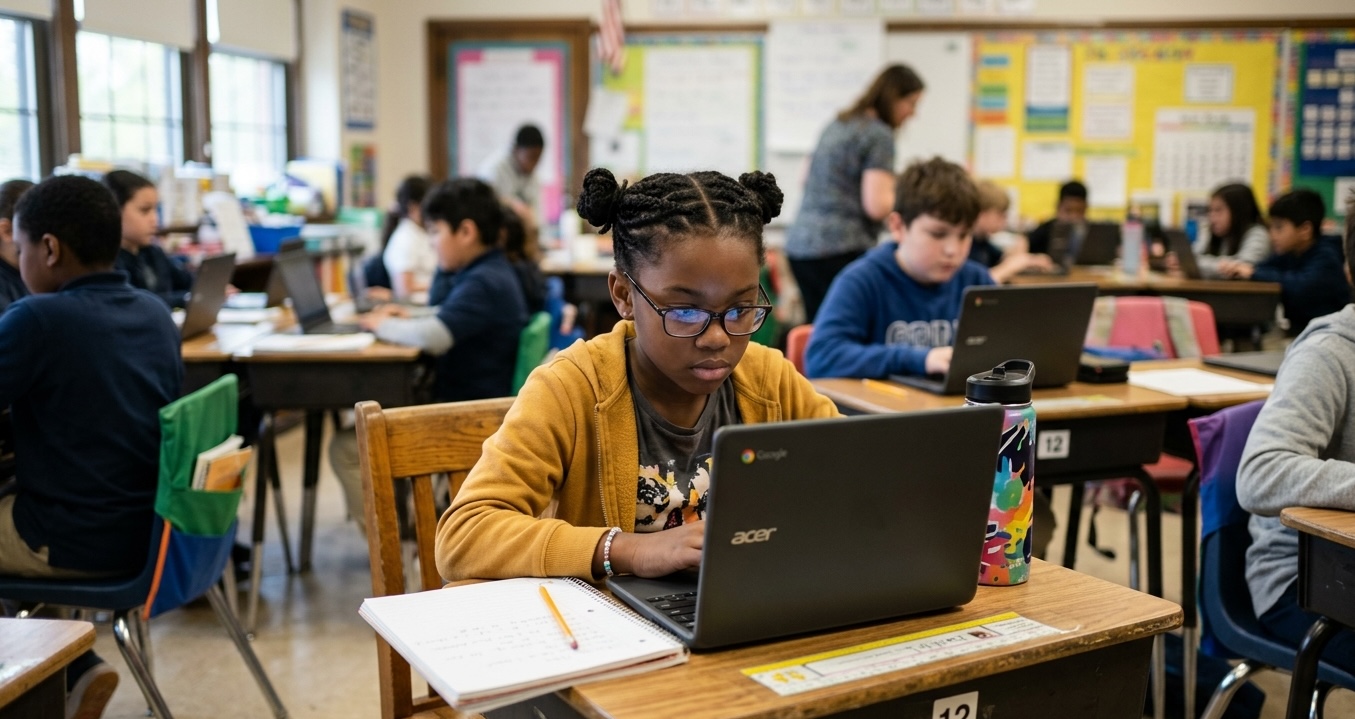
Every teacher has lived this moment. A student aces Friday’s spelling test, confidently writing out “rhythm,” “necessary,” and “separate” without a smudge. The next Wednesday, that same student hands in a writing assignment and misspells all three.
It is tempting to blame the student, or the list, or the weekend. The real issue is almost always different. The student did study. What failed them was the timing of that studying, and the way the words were stored in memory in the first place.
The good news is that cognitive science has a clear answer for this problem, and it has had one for a very long time. The answer is spaced repetition: the practice of reviewing material at gradually increasing intervals over time, rather than cramming it into a single session. This guide covers what spaced repetition is, the science behind it, what it looks like in a K-8 classroom, the domains where it has been proven to work, and the tools that make it easy to put into practice.
What Is Spaced Repetition?
In plain terms, spaced repetition means reviewing material multiple times, with growing gaps between each review session. Each review happens right around the point a student is about to forget the information. That moment of effortful retrieval is precisely what strengthens the memory and makes it last.
This is the opposite of how most students study. The night before a test, a student sits down with a list of twenty spelling words and repeats them over and over in a single sitting. Cognitive scientists call this massed practice, or more colloquially, cramming. It feels productive. The words are fresh in working memory. The student can rattle them off without effort. But the memory that massed practice produces is shallow and short-lived.
A spaced approach to the same twenty words would look different. A student might review five words on Monday, revisit them along with a few new ones on Wednesday, and come back to the trickiest ones the following Monday. The total study time is similar. The retention is so much better.
A few terms are worth defining now, because they will come up throughout the rest of this article:
- Spacing effect — the robust finding that learning is more durable when study sessions are spread out over time rather than concentrated in one sitting.
- Retrieval practice (also called active recall) — the act of pulling information out of memory, as opposed to simply re-reading or re-hearing it. Testing yourself is a form of retrieval practice. Passive review is not.
- Massed practice vs. distributed practice — the two sides of the spacing coin. Massed practice is cramming. Distributed practice is spaced practice.
Spaced repetition is the practical method that combines distributed practice with retrieval: scheduled retrieval attempts, spaced out over time.
The Science Behind Spaced Repetition
One of the reasons spaced repetition deserves a place at the center of literacy instruction is that the research base is unusually old, unusually deep, and unusually consistent. This is not a trend. The findings have held up across more than a century of replication.
Key Studies at a Glance
| Study | What was studied | Key finding |
|---|---|---|
| Cepeda et al. (2006), Psychological Bulletin | Meta-analysis: 317 experiments, 839 assessments | Spacing beat massed study in 259 of 271 direct comparisons (~96%) |
| Cepeda et al. (2008), Psychological Science | 1,350+ learners, review gaps up to 3.5 months, tests up to 1 year | Best gap ≈ 20–40% of retention interval at 1 week, 5–10% at 1 year |
| Kim & Webb (2022), Language Learning | Meta-analysis: 48 experiments, 3,411 second-language learners | Medium-to-large spacing effect; equal and expanding schedules equivalent |
| Kornmeier et al. (2014), PLOS ONE | Vocabulary pairs, 6 spacing schedules, retested up to 28 days | ~85% of words retained with a 12-hour gap, the best schedule tested |
| Maye & Hurley (2026), The Clinical Teacher | Meta-analysis: 14 studies, 21,415 medical learners | SMD = 0.78 (95% CI 0.56–0.99) in favor of spaced repetition |
| Durrani et al. (2024), BMC Medical Education | 115 medical students, Anki vs. books and lectures | Effect size 0.8 on clinical problem-solving; control group did not improve |
| Ogunjobi et al. (2024), Cureus | Undergraduate microbiology course, UNC Chapel Hill | No significant exam change; confidence and perceived effectiveness rose significantly |
| Dunlosky et al. (2013), Psychological Science in the Public Interest | Review of 10 common study techniques | Distributed practice rated “high utility,” one of only two techniques to earn that rating |
The Forgetting Curve (Ebbinghaus, 1885)
The story starts with a German psychologist named Hermann Ebbinghaus. In the 1880s, Ebbinghaus ran the first rigorous experiments on memory and forgetting, using himself as the subject. He memorized lists of nonsense syllables and then tested himself at intervals to see how much he had retained.
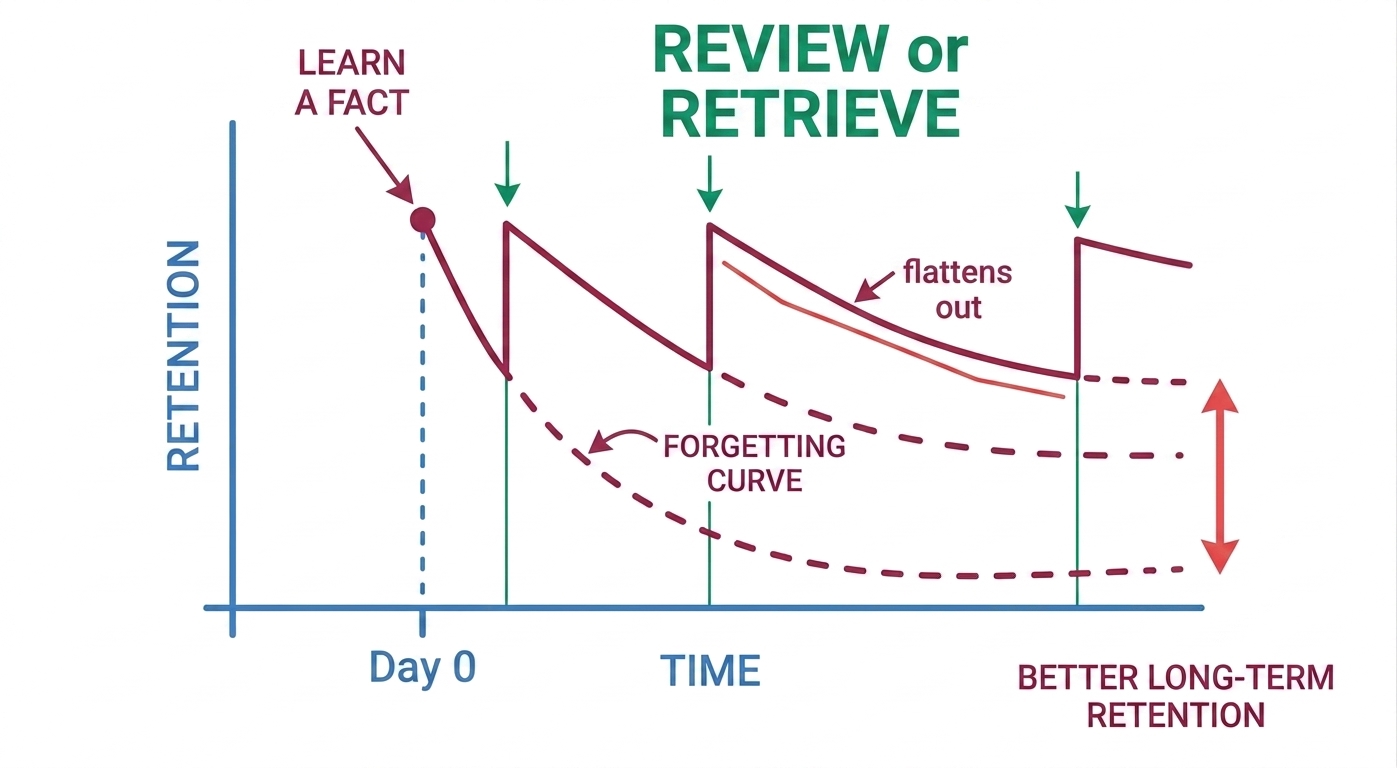
The resulting forgetting curve was striking. Newly learned information faded rapidly. Most forgetting happened within the first twenty-four hours, and the rate of loss then slowed. Without review, even material that had been learned to perfection decayed into something close to noise within days.
Ebbinghaus also noticed something hopeful. Even when information seemed fully forgotten, relearning it took less time than the original learning had. He called this savings, and it suggests something important: memories are not fully erased when they fade. They just need reinforcement to become accessible again.
For more than a century, the Ebbinghaus curve lived on in textbooks with the occasional skeptic wondering whether it would hold up under modern methods. In 2015, Murre and Dros published a careful replication in PLOS ONE and confirmed his original findings. Ebbinghaus was right.
The Spacing Effect: More Than 130 Years of Evidence
Ebbinghaus’s curve raised the obvious question: if forgetting is so fast, what is the most efficient way to fight it? The answer is what cognitive scientists now call the spacing effect.
The landmark work here is a 2006 meta-analysis by Cepeda, Pashler, Vul, Wixted, and Rohrer, published in Psychological Bulletin. The team reviewed 184 articles covering 317 experiments and 839 assessments of distributed practice. In the 271 direct comparisons of spaced versus massed study, only 12 showed no benefit or a negative effect from spacing. Spacing won in the other 259, roughly 96% of the time, across ages, subjects, and materials.
A few years later, Roediger and Butler synthesized the parallel literature on retrieval practice in Trends in Cognitive Sciences. Their conclusion: when you combine retrieval practice with spacing, forgetting over the course of a week drops substantially.
How far apart should reviews be? The best data comes from a follow-up study by the same group. Cepeda and colleagues (2008) had more than 1,350 people learn a set of facts, review them after gaps of up to 3.5 months, and take a final test up to a year later. The ideal gap grew as the test date moved further out, but it shrank as a share of that time: about 20–40% of the retention interval for a test one week away, and about 5–10% for a test one year away. A practical rule of thumb for the middle of that range is to space reviews at roughly 10–20% of the time you want to remember the material. Want a student to still remember a word list a month from now? Review roughly every three to six days. Want them to remember it a year from now? The reviews can be further apart.
What Happens in the Brain
At the neural level, each time a student successfully retrieves a piece of information from memory, the pathways that encode it are strengthened. Memory researchers call this reconsolidation. A memory that is retrieved and re-stored is, in a real sense, a stronger memory than one that was never disturbed.
Sleep matters too. Consolidation of new learning happens partly during sleep, which is one more reason that stretching practice across multiple days beats crunching it into a single night. A student who reviews on Monday, sleeps, reviews on Wednesday, and sleeps again is giving their brain multiple consolidation cycles to bake in the material.
Modern researchers have even begun to optimize this process with algorithms. Tabibian and colleagues, writing in PNAS in 2019, showed that spaced repetition schedules can be tuned mathematically to maximize retention with minimum study time.
Recent Confirmation at Scale
The most recent large-scale confirmation comes from medical education. A 2026 systematic review and meta-analysis by Maye and Hurley in The Clinical Teacher pulled together fourteen studies covering 21,415 learners (13 of them were pooled in the meta-analysis). Spaced repetition beat standard study techniques with a standardized mean difference of 0.78 (95% CI 0.56–0.99, p < 0.0001). In education research, an effect that size counts as large.
In other words: when the stakes are high and the content is dense, spaced repetition continues to outperform traditional study methods at scale.
How Spaced Repetition Works in Practice
The research is clean. The implementation is where things get interesting, because translating “review at increasing intervals” into a real classroom routine takes some thought.
The Core Mechanism
Done well, a spaced repetition system follows a simple loop:
- New or difficult material is reviewed frequently.
- As a student demonstrates mastery of a given item, the interval before the next review grows.
- If the student stumbles, the interval shrinks and the item cycles back in sooner.
The goal is to quiz each student on each item right before they would have forgotten it. This is the point of maximum retrieval effort. That moment is where the memory gets the biggest boost. Ask too soon and the work is too easy to strengthen anything. Ask too late and the memory is gone.
Algorithm-Driven Spacing
This sounds great on paper and impossible in practice. A teacher with twenty-five students and twenty spelling words per student is looking at five hundred items to track, each on its own schedule. No human is going to manage that by hand.
This is where software earns its keep. Modern spaced repetition systems use algorithms to calculate the optimal next review for each item for each individual learner. The best-known algorithm family is SM-2, originally developed for SuperMemo in the 1980s, and its modern successor FSRS (the Free Spaced Repetition Scheduler). Both work by watching how a learner responds to each item and adjusting the schedule accordingly.
The payoff for a teacher is that the bookkeeping disappears. Students do not have to decide what to study or when. The system surfaces the right material at the right time.
What This Looks Like in a Spelling Classroom
In Spelling Test Buddy, an Adaptive Learning Program spelling session follows a consistent structure. Students start with an initial test, then move through practice activities — hearing each word, seeing it spelled, using it in context, and working through word games — and finish with a final test that closes the loop.
The detail that makes this spaced repetition rather than ordinary practice is that every session presents a unique set of words for each student. The words are chosen by where each item sits on that student’s personal forgetting curve. One student might see “rhythm” again because they missed it last week. A classmate who nailed “rhythm” two weeks ago is working on something else entirely.
Sessions usually run between fifteen and twenty-five minutes, which is enough time for the full test-practice-test cycle. For older students or programs with less time, teachers can switch to a shorter “Test Only” mode, where students just take the test with their dynamically selected words and skip the games and Teach Me in between.
In either mode, the scheduling happens in the background. Teachers do not have to decide which words a student should see on any given day. The platform tracks each student’s history, runs the spacing algorithm, and surfaces the right words at the right time. The teacher’s job goes back to being what it should be: teaching.
Domains Where Spaced Repetition Has Proven Effective
One of the reasons to trust spaced repetition is that it is not a niche trick that happens to work in one context. It has been tested across subjects, age groups, and skill levels, and it keeps holding up.
Language Learning and Vocabulary Acquisition
This is the most heavily studied application, and the evidence is strong enough to have its own meta-analysis.
- Kim & Webb (2022), Language Learning. This meta-analysis pooled 98 effect sizes from 48 experiments with 3,411 second-language learners. Spacing produced a medium-to-large effect on learning compared with massed practice. Longer gaps between sessions beat shorter gaps on delayed tests, though the two were similar on immediate tests. That is the classic pattern: cramming looks fine right away and falls apart later. Equal and expanding schedules came out statistically equivalent, so the regular, spread-out review matters more than a perfectly tuned interval sequence.
- Kornmeier, Spitzer & Sosic-Vasic (2014), PLOS ONE. Participants learned German–Japanese word pairs on one of six spacing schedules, from 7 minutes to 24 hours apart, and were retested up to 28 days later. With a 12-hour gap, about 85% of the words were still remembered, the best result of the six schedules. The same spacing pattern showed up in a completely different skill (visual acuity training), which suggests spacing reflects how memory works in general, not a quirk of word lists.
- Nakata (2015), Studies in Second Language Acquisition. In a computer-based study of 128 Japanese college students learning 20 English words, the amount of spacing (massed vs. short, medium, or long gaps) had a statistically significant effect with large effect sizes. Expanding intervals showed only a limited edge over equal intervals, consistent with Kim & Webb’s conclusion.
The practical takeaway for vocabulary and spelling is the same: get the words back in front of students across days and weeks, and don’t over-engineer the exact schedule. Mainstream language apps like Memrise built their entire product around this principle.
Medical Education
Medical students face a volume of factual material that would break most adult learners. Over the last decade, spaced repetition — usually through the flashcard app Anki — has become a near-universal study strategy in medical schools. Studies have linked its use to better performance on board exams like the USMLE Step 1. The 2026 Maye & Hurley meta-analysis described above (SMD 0.78 across 21,415 learners) is the strongest summary of this evidence.
A 2024 study in BMC Medical Education by Durrani and colleagues extended the finding to clinical problem-solving. Final-year medical students on a pediatrics rotation who studied with Anki flashcards raised their scores on a 50-question clinical MCQ test from 27.9 to 30.8 over four weeks (effect size 0.8). A control group using books and lectures did not improve (27.96 to 27.22). Spaced repetition supports higher-order reasoning, not just memorization.
Mathematics
A well-known line of research by Pashler, Rohrer, Cepeda, and Carpenter found that students who learned math principles on a spaced schedule scored higher on later tests than those who used massed practice. This matters because it shows the spacing effect reaches beyond facts. It helps students remember and apply procedures. Platforms like XtraMath use a spaced, mastery-based approach to build math fact fluency, cycling students through operations and raising the difficulty as they demonstrate mastery.
Science Education
A 2022 review in Cureus by Yuan argues that spacing supports long-term conceptual understanding in science, not just fact recall. It also argues that spacing is underused in science curricula, partly because students and teachers misjudge how well cramming works. A 2024 study at UNC Chapel Hill by Ogunjobi and colleagues used spaced repetition flashcards in an introductory microbiology course. Exam scores did not change significantly (p = 0.27), but students’ confidence in succeeding (p = 0.007) and their ratings of the course’s effectiveness (p = 0.008) both improved significantly. That honest mixed result is a useful read for anyone considering the strategy at secondary or postsecondary level.
Spelling and Phonics
Spelling may be the ideal case for spaced repetition. The task is fundamentally one of item-level retrieval: given a word, produce the correct sequence of letters. That maps perfectly onto what spacing optimizes.
The traditional weekly spelling test model — introduce words on Monday, test on Friday, never revisit them — is, in the language of this post, massed practice with a deadline. Words get crammed and then, predictably, forgotten. This is the same pattern described in our post on whether spelling tests actually make students better spellers, and it is also why interleaving and spacing work so well together; we dug into the interleaving side of that story in Using Interleaving to Build Lasting Spelling Skills.
Spaced repetition through Adaptive Learning Programs flip the default. Mastered words drift into longer review cycles. Struggling words keep reappearing until they stick. Research on vocabulary learning confirms what teachers see in their own classrooms: spacing exposures to a word over time produces much better long-term retention than piling them into one session. If you want a fuller picture of the different ways spelling is assessed, our post on the types of spelling tests pairs naturally with this one.
Memory Rehabilitation
Perhaps the most striking evidence comes from clinical work with Alzheimer’s patients and individuals with amnesia. Researchers have found that spaced repetition can help even people with significant memory impairments hold onto important information longer than other methods allow. The fact that it produces durable learning under those conditions says something about how deeply it is tied to the architecture of memory itself.
Tools That Use Spaced Repetition
A landscape view is useful here, because Spelling Test Buddy is one option among several that put spacing into practice. Each tool serves a different audience.
Anki (General Purpose)
Anki is the best-known spaced repetition tool in the world. It is free, open-source, and powered by a sophisticated algorithm (now FSRS). Medical students, language learners, and self-directed adult learners swear by it. It is also highly customizable, which is both its strength and its weakness: the learning curve is steep, and it is not designed with classroom workflow or younger students in mind.
Best for: Individual learners — high school, college, or adult — who want maximum control. Website: apps.ankiweb.net
XtraMath (Math Fact Fluency)
XtraMath is a nonprofit platform focused on helping K-6 students build fluency with addition, subtraction, multiplication, and division. It uses a spaced, mastery-based approach: students work through operations, and the program adapts to their speed and accuracy. It is widely used in elementary classrooms and free for teachers.
Best for: Elementary math fact practice. Website: xtramath.org
Spelling Test Buddy (Spelling and Phonics)
Spelling Test Buddy is built specifically for K-8 classroom and homeschool spelling instruction. Teachers create word lists — or pull from hundreds of pre-made lists aligned to phonics patterns — and students practice through online tests, spelling games, digital sorts, and the Teach Me feature.
With Adaptive Learning Programs, spaced repetition is built into the platform. Words that students miss are automatically cycled back into future practice at increasing intervals. Students are not just practicing for Friday’s test; they are building lasting recall.
A few other things worth knowing:
- Auto-grading saves teachers a significant amount of time.
- Progress reports make it easy to track individual students and spot patterns.
- Differentiated instruction is straightforward: different word lists for different student groups based on skill level.
- The platform is aligned with the Science of Reading.
For a side-by-side look at where it fits next to other options, see our comparison of classroom spelling apps.
Best for: K-8 classroom spelling, phonics reinforcement, and intervention. Website: spellingtestbuddy.com
Quizlet (General Study Tool)
Quizlet is popular with students for flashcard-based study across many subjects, with multiple study modes — flashcards, learn, test, match, and games. It does incorporate some spaced review features, though its algorithm is less sophisticated than dedicated SRS tools like Anki.
Best for: General-purpose review across subjects, especially for older students. Website: quizlet.com
Brainscape (Confidence-Based Repetition)
Brainscape uses a confidence-based rating system: learners rate how well they know each card, and cards rated as less well-known appear more frequently. It offers both user-created and pre-made decks across many subjects, with a more polished interface than Anki.
Best for: Self-directed learners who want a polished SRS experience. Website: brainscape.com
Other Notable Tools
- Memrise — Language-focused, with community-created courses and built-in SRS.
- RemNote — Combines note-taking with spaced repetition flashcards.
- IXL — Adaptive practice platform for math and ELA. A 2025 study summarized by IXL reported that students learned challenging skills more effectively when they spread practice across multiple sessions instead of one sitting.
Common Misconceptions About Spaced Repetition
A few objections come up often enough that they are worth addressing directly.
“It’s just flashcards.” Flashcards are one delivery mechanism, but spaced repetition is a scheduling principle. It can be applied to tests, games, writing exercises, word sorts; any activity in which a student retrieves information from memory. In Spelling Test Buddy, the same spacing logic drives the tests, the games, and the sorts alike.
“It only works for memorization, not deeper learning.” The research does not bear this out. Spaced repetition has been shown to improve performance on tasks that require application and reasoning, including math problem-solving and clinical decision-making. Retrieval strengthens the use of information, not just its storage.
“My students already practice every night.” Amount of practice is not the same as schedule of practice. Practicing the same twenty words every night for one week is massed practice; it just happens to be stretched across seven sessions. Reviewing those words across several weeks, with revisits after they appear to be learned, is spaced practice. That is the version that sticks.
“I don’t have time to manage a review schedule for my 30 students.” This is exactly the objection that technology solves. Software like Spelling Test Buddy automates the scheduling so teachers do not have to track it by hand. The teacher chooses the words and the goals; the platform handles the when.
What Sticks Is What Matters
The purpose of spelling instruction is not to pass Friday’s test. It is for students to spell words correctly in their writing — in book reports, in emails, in college application essays, in professional work — months and years after they first learned them.
Spaced repetition is one of the most well-supported strategies in all of learning science. The evidence spans more than 130 years, hundreds of studies, and a wide range of ages and subjects. It works. The hard part has always been implementation: no individual teacher can track, by hand, which words each student needs to review and when.
That is exactly the problem Spelling Test Buddy was built to solve.
Ready to bring spaced repetition into your spelling instruction? Try Spelling Test Buddy free for 14 days and see how automatic practice scheduling can help your students remember what they learn. Teachers can also learn more on our How It Works page, and school and district leaders can find specifics on the For Schools and Districts page.
Looking for a broader view of how spelling gets assessed and taught? Browse the other guides in our Resources section, including UFLI and Spelling and Phonemes vs Morphemes.
Frequently Asked Questions
What is spaced repetition?
Spaced repetition is the practice of reviewing material at gradually increasing intervals over time, rather than cramming it into a single session. Each review happens right around the point a student is about to forget the information, and that moment of effortful retrieval is what strengthens the memory and makes it last.
How is spaced repetition different from cramming?
Cramming — what cognitive scientists call massed practice — packs all study into one sitting. The material feels fresh in working memory, but the resulting memory is shallow and short-lived. Spaced (distributed) practice spreads the same study time across multiple sessions, which produces far more durable long-term retention.
Does spaced repetition work for spelling?
Yes. Spelling is fundamentally item-level retrieval — given a word, produce the correct sequence of letters — which is exactly what spacing optimizes. Mastered words drift into longer review cycles while struggling words keep reappearing until they stick, producing much better long-term retention than one-and-done weekly tests.
How far apart should spaced reviews be?
A practical rule from the research is to space reviews at roughly 10–20% of the time you want to retain the material. To still remember a word list a month from now, review roughly every three to six days; to remember it a year from now, the reviews can be spaced further apart.
What tools use spaced repetition?
General-purpose tools include Anki, Quizlet, and Brainscape; XtraMath applies it to math facts. For K-8 spelling specifically, Spelling Test Buddy builds spaced repetition into its Adaptive Learning Programs, automatically cycling missed words back into future practice at increasing intervals.
Recommended Further Reading and References
- Ebbinghaus, H. (1885). Über das Gedächtnis (Memory: A Contribution to Experimental Psychology).
- Murre, J. M. J., & Dros, J. (2015). Replication and Analysis of Ebbinghaus’ Forgetting Curve. PLOS ONE. Link
- Cepeda, N. J., Pashler, H., Vul, E., Wixted, J. T., & Rohrer, D. (2006). Distributed Practice in Verbal Recall Tasks: A Review and Quantitative Synthesis. Psychological Bulletin. Link
- Roediger, H. L., & Butler, A. C. (2011). The Critical Role of Retrieval Practice in Long-Term Retention. Trends in Cognitive Sciences. Link
- Tabibian, B., et al. (2019). Enhancing Human Learning via Spaced Repetition Optimization. PNAS. Link
- Cepeda, N. J., Vul, E., Rohrer, D., Wixted, J. T., & Pashler, H. (2008). Spacing Effects in Learning: A Temporal Ridgeline of Optimal Retention. Psychological Science, 19(11), 1095–1102. Link
- Maye, J. A., & Hurley, F. (2026). The Effectiveness of Spaced Repetition in Medical Education: A Systematic Review and Meta-Analysis. The Clinical Teacher, 23(2), e70353. Link
- Kim, S. K., & Webb, S. (2022). The Effects of Spaced Practice on Second Language Learning: A Meta-Analysis. Language Learning, 72(1), 269–319. Link
- Nakata, T. (2015). Effects of Expanding and Equal Spacing on Second Language Vocabulary Learning. Studies in Second Language Acquisition, 37(4), 677–711. Link
- Kornmeier, J., Spitzer, M., & Sosic-Vasic, Z. (2014). Very Similar Spacing-Effect Patterns in Very Different Learning/Practice Domains. PLOS ONE, 9(3), e90656. Link
- Durrani, S. F., et al. (2024). Effectiveness of Spaced Repetition for Clinical Problem Solving Amongst Undergraduate Medical Students Studying Paediatrics in Pakistan. BMC Medical Education, 24, 676. Link
- Ogunjobi, F., Alexander, S. M., & Cramer, L. (2024). Usage of Spaced Repetition Flashcards to Improve Educational Outcomes in Microbiology. Cureus, 16(10), e70994. Link
- Yuan, X. (2022). Evidence of the Spacing Effect and Influences on Perceptions of Learning and Science Curricula. Cureus, 14(1), e21201. Link
- Kang, S. H. K. (2016). Spaced Repetition Promotes Efficient and Effective Learning: Policy Implications for Instruction. Policy Insights from the Behavioral and Brain Sciences. Link
- Dunlosky, J., Rawson, K. A., Marsh, E. J., Nathan, M. J., & Willingham, D. T. (2013). Improving Students’ Learning With Effective Learning Techniques. Psychological Science in the Public Interest, 14(1), 4–58. Link
- Spelling Test Buddy Blog: What Are the Different Types of Spelling Tests?
- Spelling Test Buddy Blog: Using Interleaving to Build Lasting Spelling Skills