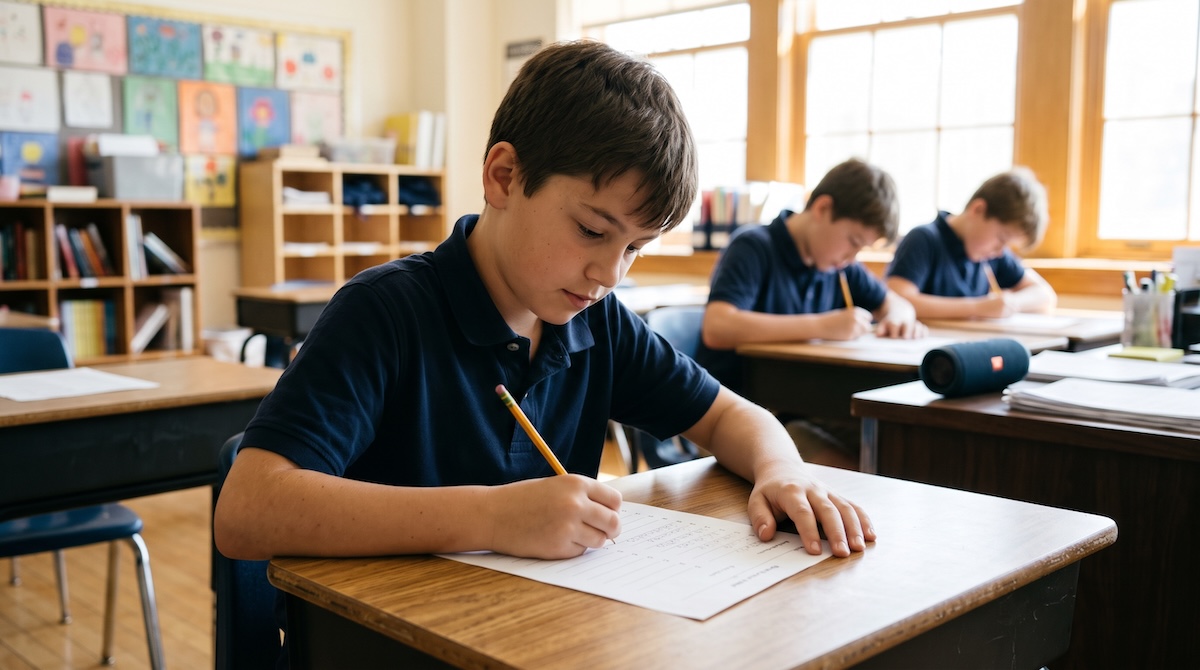
PSIA Spelling is a written spelling test for Texas private, parochial, and home school students in grades 2 through 8. Students hear words from a recording and write them down. About three quarters of the words come from the official PSIA Spelling List, and the last quarter are “outside words” that aren’t on the list at all. This guide covers the 2026-2027 rules, the meet dates, how scoring works, and a study plan that leaves room for the parts of the test that a list can’t cover.
I make Spelling Test Buddy, and some of this guide explains how to use it for PSIA practice. Everything about the rules comes from PSIA’s own published contest materials, and I link to them throughout. If anything here disagrees with what your District director tells you, go with your director.
What is PSIA?
The Private Schools Interscholastic Association (PSIA) is the academic competition league for Texas private, parochial, and home schools in grades 1-8. 2026-2027 is its 30th season, and it offers about 20 contests, from Number Sense to Storytelling to Spelling. Public school students in Texas compete in UIL instead; if you coach both, our guide to the UIL A+ spelling test format and scoring covers the differences.
PSIA competition runs in three rounds:
- Campus. Each school picks its own entrants, however it likes.
- District. Up to three students per grade section from each school.
- State. The top two finishers from each District section in grades 4-8.
Schools register as “A” (fewer than 27.5 students per grade on average) or “AA” (27.5 or more), and each class has its own State meet. Homeschools can join for $60 and compete in either class.
2026-2027 PSIA dates
These come from PSIA’s tentative 2026-2027 calendar, dated June 4, 2026.
| Date | What happens |
|---|---|
| Nov 1, 2026 | Regular registration deadline |
| Dec 15, 2026 | Late registration and participation change deadline |
| Feb 5, 2027 | First day a District meet can be held |
| Mar 6, 2027 | Last day a District meet can be held |
| Apr 10, 2027 | State meet for “A” schools |
| Apr 24, 2027 | State meet for “AA” schools |
Your District sets its own meet date inside the February 5 to March 6 window, so ask your director early. That date is the one your study plan should work back from.
The 2026-2027 PSIA spelling rules
Grades and sections
Grades 2, 3, 4, 5, and 6 each compete as their own section. Grades 7 and 8 compete together. Each school can enter up to three students per section at District.
Grades 2 and 3 end at District. They don’t advance to State. In grades 4, 5, 6, and 7-8, first and second place advance, and third place is the alternate.
Word lists
PSIA posts this year’s lists as free PDFs on its official Spelling contest page, and the lists change every year:
- Grades 2-3 list: 600 words, from “ability” and “aboveground” through “zookeeper”
- Grades 4-5 list: 800 words, with a jump to words like “bureaucrat” and “butterfingered”
- Grades 6-8 list: 900 words, including “abeyance,” “camaraderie,” and “zloty”
The lists show the capitalization PSIA expects, and some entries accept two spellings (“canister, cannister”). Print them from PSIA’s site rather than from an old copy a parent passed along. A 2025 or 2026 list won’t match this year’s test, and PSIA posts any list corrections in its newsletter.
Test length and outside words
| Grades | Words on test | List words | Outside words |
|---|---|---|---|
| 2-3 | 50 | 37 | 13 |
| 4-5 | 75 | 56 | 19 |
| 6, 7-8 | 100 | 75 | 25 |
An outside word is any word in the Merriam-Webster’s Collegiate Dictionary, 12th Edition, that isn’t on the study list. Outside words come at the end of the test, and the recording gives a definition, an example sentence, or both for each one.
Derivatives (grades 4-8)
Some test words are derivatives of list words: the same root with a different tense, part of speech, prefix, or suffix. PSIA’s derivatives explainer says to expect about 8 on the grades 4-5 test and about 14 on the grades 6-8 test. Its examples from the 2024 tests include “radius” becoming “radii,” “erode” becoming “erosion,” and “secede” becoming “secessionist.”
This is where students who memorized the list letter by letter lose points. Knowing “voluntary” doesn’t help much if you’ve never thought about how it changes in “voluntarily.”
How the test is given
- A recording pronounces each word twice, at about 5 to 6 words per minute.
- The recording also reads the question number, and each word must go on the matching numbered blank.
- Nobody repeats a word, and students can’t ask for one again.
- Students write in pencil or dark ink, and they can erase or cross out without penalty.
Scoring
- 5 points for each list word spelled correctly
- 7 points for each outside word spelled correctly
- No penalty for a wrong or blank answer, so students should always guess
Letter formation counts. Capital letters must match the list, i’s must be dotted, and accent marks and umlauts must be there. British spellings are marked wrong unless the list allows them. Graders check disputed words against the PSIA list and the Collegiate Dictionary, 12th Edition.
Here’s why the outside words matter so much. On the grades 6-8 test, 25 outside words are worth 175 of the 550 possible points, close to a third. Two students who both know every list word can finish far apart on outside words alone.
How to prepare for PSIA spelling
PSIA’s own advice is to teach “the rules of the English language, prefixes, suffixes, and root words.” The list gets your students most of the way. Spelling patterns, roots, and word-building cover the rest.
1. Split the list into weekly chunks
From early November to an early February District meet, you have about 12 weeks. A 900-word list is about 75 words a week. Work back from your actual District date:
| Grades | List size | Words per week over 12 weeks |
|---|---|---|
| 2-3 | 600 | 50 |
| 4-5 | 800 | about 67 |
| 6-8 | 900 | 75 |
Leave the last two weeks for full practice tests and the words students keep missing.
2. Review missed words more often than known ones
When a student practices all 900 words equally, most of their time goes to words they already know. Research on spaced repetition and the forgetting curve shows retention is better when review is spread over weeks and each word comes back right before it would be forgotten. In practice, the hard words should show up every few days and the easy ones much less often.
You can run this with flashcards and a box system. In Spelling Test Buddy, you’d paste each weekly chunk in as a list and turn on an Adaptive Learning Program, which brings missed words back more often and moves mastered words to longer intervals for each student.
3. Teach word families, not single words
For derivatives, take a handful of list words each week and have students build the other forms: noun to adjective (“charisma” to “charismatic”), verb to noun (“erode” to “erosion”), adding “-ly,” “-ness,” or “-ist.” Latin and Greek plurals (“radius” to “radii,” “quantum” to “quanta”) are worth their own lesson for grades 6-8.
4. Practice outside words on purpose
Outside words are worth the most and can’t be memorized. Build a running list of words your students should know but that aren’t on this year’s list, such as last year’s PSIA list, school vocabulary words, and words from their reading. Give these with a definition or sentence, the same way the test does, and keep them last in each practice test.
5. Rehearse the test conditions
At least a few times before District, give a full-length practice test that matches the real one:
- Each word said twice, about five words a minute
- Numbered blanks, with nothing repeated
- Outside words last, with a definition or sentence
- Graded strictly for capitals, dotted i’s, and accent marks
The PSIA test is handwritten, so finish each rehearsal on paper. Our free printable spelling test papers work for this. For daily practice between rehearsals, an audio test is faster to give and grade. Our free spelling test generator reads each word aloud with a sentence, which is close to how the PSIA recording sounds.
Using Spelling Test Buddy for PSIA practice
Spelling Test Buddy is a good fit for coaching a PSIA team, though not a perfect one. Here’s what it does well:
- Audio for any list. Paste in a chunk of the PSIA list, and every word gets audio and an example sentence. Nobody has to read 75 words aloud.
- Each student drills their own misses. Adaptive Learning Programs track each student and bring back the words they get wrong.
- One login for the whole team. You can see who’s on track at every grade level without grading stacks of paper.
- Homeschool friendly. A parent can run it at home with one or two children.
“I’m a parent trying to help my daughter prepare for the PSIA in February. She has a list of 600 words to learn and is in 2nd grade.
She was really enjoying it and allows her to be able to practice independently.”
What it doesn’t do:
- Students type, they don’t handwrite. You still need paper rehearsals for handwriting and letter formation.
- No PSIA-specific scoring. It doesn’t score with PSIA’s 5- and 7-point values.
- No preloaded PSIA lists. You copy the words in from PSIA’s PDFs yourself.
Frequently Asked Questions
What is PSIA?
PSIA, the Private Schools Interscholastic Association, runs academic competitions for private, parochial, and home schools in Texas, grades 1 through 8. Students compete at their campus, then at a District meet, and in most contests the top finishers advance to a State meet.
Where do I find the 2026-2027 PSIA spelling word lists?
PSIA posts the 2027 lists for grades 2-3 (600 words), grades 4-5 (800 words), and grades 6-8 (900 words) as free PDFs on the Spelling page of psiaacademics.org, along with the contest rules and a sheet explaining derivatives.
How many outside words are on the PSIA spelling test?
About 25%. Grades 2-3 get 13 outside words on a 50-word test, grades 4-5 get 19 on a 75-word test, and grades 6-8 get 25 on a 100-word test. Outside words can be any word in the Merriam-Webster’s Collegiate Dictionary, 12th Edition, that isn’t on the list. They come at the end of the test and are worth 7 points each instead of 5.
Do PSIA grades 2 and 3 spelling advance to State?
No. For grades 2 and 3, the spelling contest ends at the District meet. In grades 4, 5, 6, and 7-8, first and second place at District advance to State, and third place is the alternate.
When are the 2026-2027 PSIA District and State meets?
On PSIA’s tentative 2026-2027 calendar, District meets can be held from February 5 to March 6, 2027. The State meet for A schools is April 10, 2027, and the State meet for AA schools is April 24, 2027. Check with your District director for your meet’s exact date.
How is PSIA spelling different from UIL spelling?
Both are written tests read from a recording at about five words per minute. UIL serves Texas public schools and deducts a point per miss, with tiebreaker words. PSIA serves private schools and homeschools, awards 5 points per list word and 7 per outside word, uses the Merriam-Webster’s Collegiate Dictionary, 12th Edition, as its authority, and includes derivatives of list words for grades 4-8.
Ready to get started?
Try Spelling Test Buddy today, for free!
Start Creating Tests, Practice, and Games